






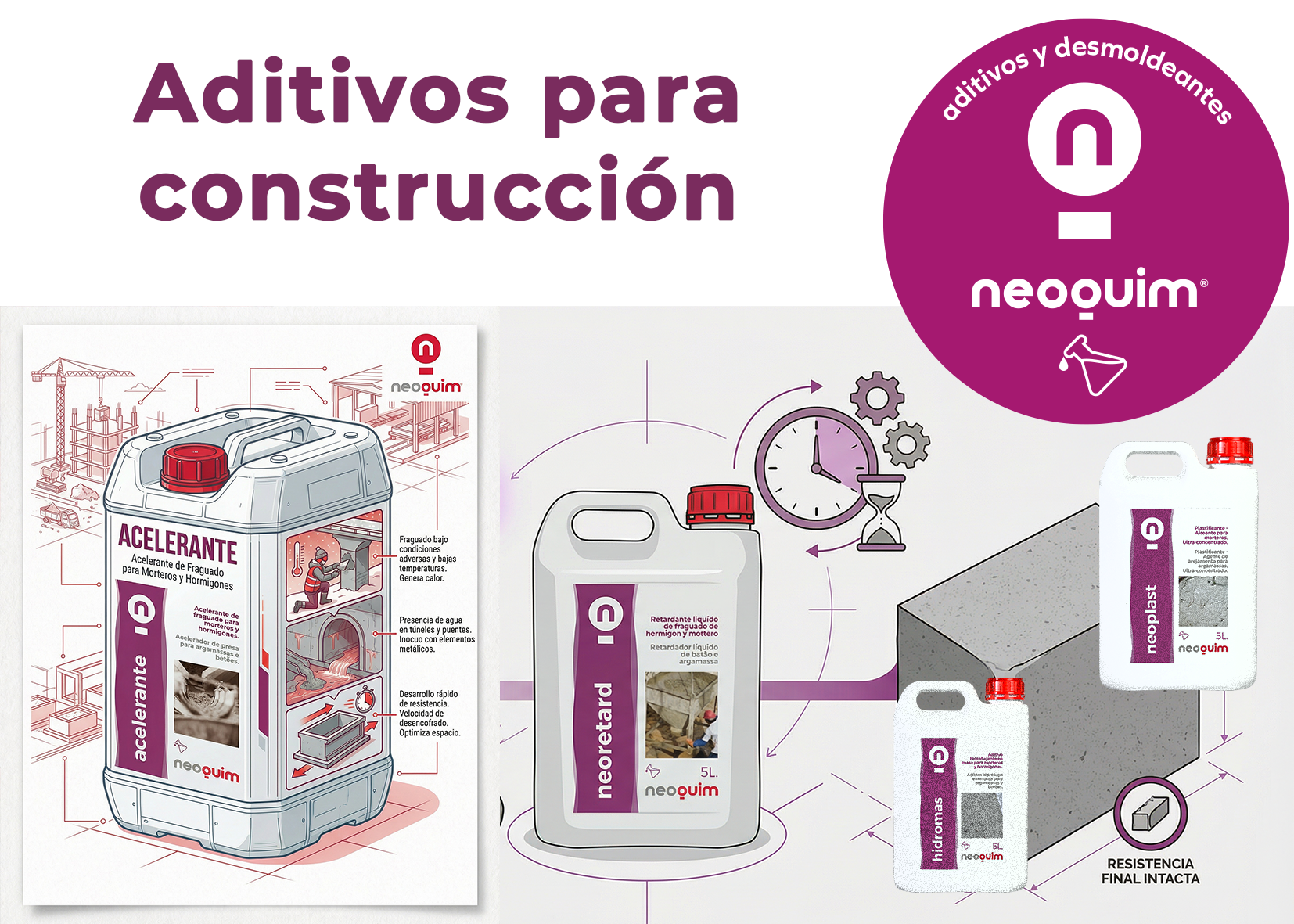
On site, concrete does not turn out well by chance. It turns out well when you control the water, consistency, setting, compaction, curing… and, above all, when you choose the right chemistry for the actual challenge in front of you: extreme heat, cold, long pours, high structural demand, waterproofing, formwork removal deadlines, pumping, exposed finishes, or durability against freeze–thaw cycles. This is whereconcrete additives come into play, not as an optional extra, but as a technical control tool. And if what you are looking for is real performance (fewer incidents, less rework, and a more stable result batch after batch), you need to know what each family does, when to use it, and what mistakes to avoid. Throughout this guide you will understand thetypes of additives for concrete, how they affect the fresh and hardened state, what criteria are used to choose them on site and why, in many situations, a good additive is the most cost-effective shortcut to durability.
What is an additive and why does a professional consider it indispensable?
Achemical additive is a substance that is incorporated into the concrete (usually in small doses relative to the cement) to controllably modify properties such as workability, setting time, water reduction, impermeability, resistance to environmental cycles, or stability during transport and placement. In professional terms, the value of an additive is measured by three things:1. Process control: you make predictable what would otherwise depend too much on the weather or the operator.2. Optimization of the water/cement ratio: less effective water means less porosity and more strength.3. Risk reduction: cracking, segregation, lack of compaction, leaks, sagging, cold joints, delayed setting or too fast setting. The additive does not fix poorly designed concrete, but it turns a correct design into a robust result.
Types of concrete additives and what problem each one solves
When someone asks for the best additive, the correct answer is thatit depends on the problem. That is why, before buying, a diagnosis must be made. These are the main types of concrete additives used on-site with a professional approach:
1) Plasticizers and water reducers
They increase fluidity or allow maintaining consistency with less water. Result: a more compact, less porous mixture with better final strength. Ideal for pumping, easier vibrating, and more uniform finishes.When to use it: • When you need workability without adding too much water. • When you want to improve strength and durability by reducing porosity.
2) Superplasticizers (high performance)
If the challenge is to achieve high fluidity with a strong water reduction (or even self-compacting concrete), this family is what makes the difference. When to use it: • Densely reinforced elements. • Exposed finishes or complex geometries. • High pouring rates with good stability.
3) Setting (and/or hardening) accelerators
Here appears one of the most sought-after points on site, which is to gain time without sacrificing strength. • Aconcrete accelerator reduces the initial/final setting time, allowing formwork removal sooner and advancing phases. • When properly applied, it improves productivity in winter or when the schedule is tight. When to use it: • Low temperatures. • Urgent repairs. • Prefabrication or quick formwork removal (always validating compatibilities).
4) Setting retarders
When heat or logistics work against you, you need open time. A concrete retarder prolongs the workability time and reduces the risk of cold joints in long pours. When to use it: • Hot climates. • Long transports from the plant. • Large slabs or continuous pours where continuity is critical.
5) Integral water repellents and waterproofers
If the problem is moisture, it is not enough to “paint on the outside” when leaks already appear. The professional solution usually starts in the mass: a mass water repellent works by reducing capillary absorption and hindering the passage of water within the matrix. When to use it: • Foundations, basements, walls in contact with the ground. • Tanks, pits, wet areas, or exposed structures. • Construction where later maintenance is expensive or complicated.
6) Air entrainers
They introduce controlled microbubbles that improve resistance to freeze–thaw cycles. They are especially relevant in environments where water enters, freezes, and expands. When to use it: • Outdoors in cold climates. • Pavements or elements exposed to aggressive thermal cycles.
7) Stabilizers, antifoaming agents, and rheological modifiers
Less well-known but very useful when there are problems with segregation, bleeding, complex pumping, or the need for cohesion. When to use it: • Concrete pumped to height. • Mixes with difficult aggregates or compromised gradations. • When you need stability without losing workability
Recommended additive table according to construction situation
| Real situation on site | Typical risk | Recommended additive |
| High heat and long pour | Cold joints, loss of workability | Retarder |
| Winter or very tight deadlines | Late formwork removal, low productivity | Accelerator / accelerating agent |
| Very ‘watery’ concrete to work with | Lower strength, high porosity | Water reducer / plasticizer |
| Basement with risk of leakage | Moisture, efflorescence, deterioration | Mass water-repellent |
| Exterior with freeze–thaw | Cracking, spalling | Air entrainer |
| Difficult pumping or segregation | Gravel nests, low cohesion | Rheological modifiers / stabilizers |
Quality vs price: why product concentration and consistency matter
On-site, the real cost is not the drum, it’s thecost of failure. A cheap additive that forces you to dose by eye, that changes from batch to batch, or that reacts differently depending on the cement can become very expensive in:
- Setting delays or too rapid setting.
- Variations in consistency (unstable pumping).
- Irregular finishes or more cracking.
- Lower durability, porosity, and leaks in the medium term.
A quality product usually provides:
- More efficient dosing (less variability).
- More predictable results (fewer surprises from weather or batch).
- Better compatibility when working with common cements and stable protocols.
- Less waste and better logistics if the concentration is well optimized.
How to choose the right additive?
Before ordering an additive, answer these questions:1. What do you need to control: workability, setting, impermeability, durability, pumping?2. What is the climate and execution window? (temperature, wind, sun exposure).3. What will the installation be like? (pumping, direct pouring, vibrating, finishing).4. Are there time restrictions? (stripping of formwork, opening to traffic, subsequent phases).5. Which risk is more expensive if it occurs? (basement leakage, slab cracking, cold joints in large pours).
Common mistakes with additives and how to avoid them
• Using higher doses just in case: overdosing can cause segregation, delays, or finishing problems.• Not controlling the total water: the additive does not compensate for a poorly designed water/cement ratio.• Mixing families without validating compatibility: especially with accelerators and superplasticizers.• Not adapting to the climate: the same design can behave differently in August than in January. •Not doing a prior test: a test under real conditions avoids surprises during the major pour.
Standard ISO 9001 and 14001
In professional projects, in addition to performance, support matters: traceability, controls, and consistency. Requesting technical documentation, datasheets, dosage recommendations, and real support is part of serious work. If you work with suppliers that operate under quality and environmental control systems (for example, ISO 9001 and ISO 14001), you will usually have an advantage with stable processes, homogeneous batches, and better traceability. On-site, that stability translates into less variability and fewer surprises.
Frequently asked questions about concrete additives
Do additives increase the final strength of concrete?
It depends. Water reducers can increase final strength by reducing porosity, but an accelerator may prioritize early strength without necessarily improving 28-day strength. The objective must be specified: initial, final, or both resistance.
Can I use an accelerator and a water repellent at the same time?
Sometimes yes, but compatibility and dosage must be validated. In professional construction, this is decided with the technical datasheet and a prior test to avoid unwanted effects.
Which is more advisable, to retard or to accelerate?
It is not better, it is correct for your scenario. If it is hot and the pour is long, retarding reduces risks. If it is cold and you need speed, accelerating is logical.
Does a mass water repellent prevent any leakage?
It greatly helps to reduce capillary absorption, but real impermeability also depends on joints, cracks, design, compaction, curing, and construction details. It is a system, not just a product. In conclusion, concrete is a demanding material and real construction even more so. Choosing well among the different concrete additives is, in practice, choosing stability: less water, better workability, controlled setting, durability, and fewer future problems. If your goal is a professional result (and not just crossing your fingers with each pour), the most cost-effective decision is almost always the same: diagnose the challenge, select the appropriate additive, dose correctly, and validate with a prior test. Well-used chemistry not only solves problems: it prevents them from appearing. Other similar articles: Additives for diesel fuel. Bonding bridges.



 Neoquimito