






The global concern for the preservation of the environment has encouraged different governments to adopt increasingly restrictive measures to reduce the atmospheric pollution in our surroundings. One of the measures adopted by the EU to conserve the environment directly affects all diesel cars. On the one hand, their engines have been technologically modified to increase efficiency and also reduce the polluting gases they emit, and on the other hand, the composition of the diesel fuel they run on has been changed over the past few years. In this regard, over the past 20 years, the regulations governing fuel marketing have required oil companies to drastically reduce the sulfur content in the diesel supplied, establishing a maximum limit of 2000 ppm in 1994, which has gradually been reduced to 10 ppm in 2009. This reduction in sulfur content, combined with the incorporation of a high percentage of synthetic ingredients, such as biodiesel, has resulted in current diesel exhibiting, compared to traditional diesel, the following characteristics:
- Lower lubricating capacity: Sulfur is an excellent lubricating additive that helps maintain low friction in the moving parts that operate in the fuel injection system, such as pumps or injectors. Its reduction has resulted in the operation of these systems not being as smooth and progressive, therefore their wear is more pronounced and their useful life is shorter.
- Greater tendency to contain water: Biodiesel is a synthetic component chemically obtained from different vegetable oils and has a high capacity to absorb water. In this way, fuel blended with biodiesel has a greater tendency to “capture” water and distribute it throughout the fuel. This fact implies that problems of corrosion and oxidation of the metals with which they are in contact may appear.
- Greater ease of being contaminated by microorganisms: Sulfur is a good biocidal ingredient, that is, it slows down or inhibits the appearance of microorganisms in the fuel. Its reduction involves having a diesel fuel with a greater tendency for bacteria to proliferate in it, with the consequent appearance of “biomass gels” that clog filtration systems, reduce fuel efficiency (it burns worse) and also accelerate corrosion processes.
The drop in fuel quality due to the reduction of its sulfur content and the addition of biodiesel in its composition generates a series of problems that are easily detectable when the degree of microbiological infection is high. The most notable are:
- Clogging of filters and blockage of drainage systems due to biomass gels.
- Reduction of the flow in the fuel delivery system and in the nozzles of refueling stations.
- Appearance of corrosion on the walls of tanks and internal elements of the vehicle’s injection system.
- Breakage of injectors due to the presence of water in the fuel.
- Loss of vehicle power due to microbiological degradation of the fuel.
These problems can be reduced, or even completely eliminated, by restoring the quality of diesel fuel through the use of chemical additives (products that are added to diesel in very small amounts):
- The use of broad-spectrum bactericidal additives allows the fuel to have greater resistance to bacterial contamination, avoiding problems associated with the presence of microorganisms. In this regard, it is recommended to avoid those biocides that are not specific for diesel, or those called ‘formaldehyde generators.’ (While the use of a non-specific biocide can further reduce fuel quality, formaldehyde-generating biocides are extremely toxic to the operator).
- The use of combustion-enhancing additives and water demulsifiers allows for the elimination of problems associated with the fuel’s tendency to absorb water while restoring its energy capacity. In this sense, it is recommended to avoid those additives that base their ‘energy’ on aggressive solvents like kerosene, as they have a high tendency to dry out seals and gaskets, causing costly breakdowns, mainly in the fuel injection pump.
- The use of lubricating additives allows the restoration of the fuel’s lubricity, thereby extending the life of systems such as fuel pumps and injectors. The highest quality ones are those that, in addition to providing lubricity to the fuel, improve its “anticorrosive” capacity.
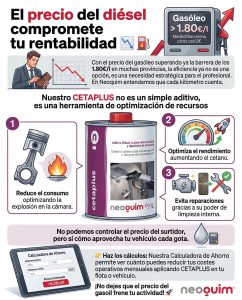
In the market, there are also chemical additives that combine the advantages of the aforementioned additives into a single chemical product. An example of this type of additive isCETAPLUS BACTER.Cetaplus Bacter is a multifunctional additive for standard diesel fuel that increases its quality, obtaining a premium “modern composition” diesel with the quality of an “old composition” diesel. Its use is extremely simple and also economically advantageous: It is added to the fuel tank before refueling diesel at a ratio of 1:1000 (1 L of cetaplus bacter for 1000 L of fuel).
Cetaplus Bacter prolongs the lifespan of your vehicle since:
- It has broad-spectrum biocidal action without using formaldehyde releasers, meaning it is not dangerous for the operator. In addition, it prevents the formation of “biomass gels.”
- It demulsifies water contained in the fuel, improving its settling. Thanks to this quality, it prevents internal corrosion and oxidation processes caused by the water contained.
- It improves the fuel’s filterability index at low temperatures, thereby improving cold engine start.
- Disperses paraffins, sludge, and resins contained in the fuel itself. In this way, it keeps the injectors clean for longer, while smoothing the operation of the injection pumps.
- Increases the cetane rating of the fuel. Thanks to this, the diesel gains greater fuel capacity, improving engine performance and power, while reducing starting time.



 Neoquimito